
Put grain analysis and reviewing crop nutrition on this year's harvest 'to-do' list
As combines roll and the growing season draws to a close, now is the ideal time for farmers to step back and assess whether their crop nutrition strategies worked or didn’t.
In a recent NUTRI-CHECK NET webinar, ADAS crop physiologists Dr Sarah Kendall and Dr Tamara Fitters shared how grain analysis and post-harvest reviews can play a pivotal role in refining nutrient strategies for future seasons.
Many farmers are already diligent about planning their crop nutrition at the beginning of the season, but few revisit and adjust those plans as the season progresses. Fewer still conduct a thorough review. For those who want to know how well their crop nutrition plan performed ahead of next year’s, taking the time to review nutrient uptake success at harvest is key, says Dr Sarah Kendall.
Sarah commented, “Most farms will determine the success of their nutrient management plans by yield alone, irrespective of the fact that non-nutritional factors will also play a role in yield. Grain analysis highlights if the nutrients available to the crop were actually sufficient, deficient, or excessive – without this crop ‘post-mortem’, you will be missing vital data for improving crop performance and streamlining your nutrition plan next year.”
Watch the full webinar
Grain analysis to avoid making nutrition ‘assumptions’
Dr Tamara Fitters, crop physiologist at ADAS, went on to explain how grain analysis helps uncover the true picture of nutrient uptake.
“Farmers are required to assess their soils every three to five years so in most cases, we can estimate how much nutrition is in the soil, and we know what inputs we’ve applied. However, it is really hard to determine how many nutrients are lost to the water or air. By assessing grain at harvest, we can identify what nutrients, if any, the crop was missing for optimal growth.”
Very often, growers will look to industry guidelines to create a crop nutrition plan but Tamara warns that making assumptions about the nutritional needs of a particular field this way could prove to be a mistake.
“Through our grain analysis and benchmarking service YEN Nutrition, we analysed the nutrient content of 1700 crops from 2017 to 2021, and compared these with standard nutrient figures recommended in RB209. The analysis showed that, depending on the field, nutrient recommendations in RB209 can sometimes overestimate nutrition needs – particularly with phosphorus and potassium.”
Achieving ‘economic optimum’
Without conducting a nutrition review, Tamara adds that farmers could also unknowingly miss their ‘economic optimum’ – the point at which fertiliser efficiency and yield are maximised.
“Underapplying nutrients could lead to yield loss; overfertilising is an unnecessary cost that will eat into profits and risks environmental pollution. We all want to get nutrition right, but that’s almost an impossible task without understanding what the crop captured or calculating offtakes with grain analysis.”
Start planning next year with a field nutrient account
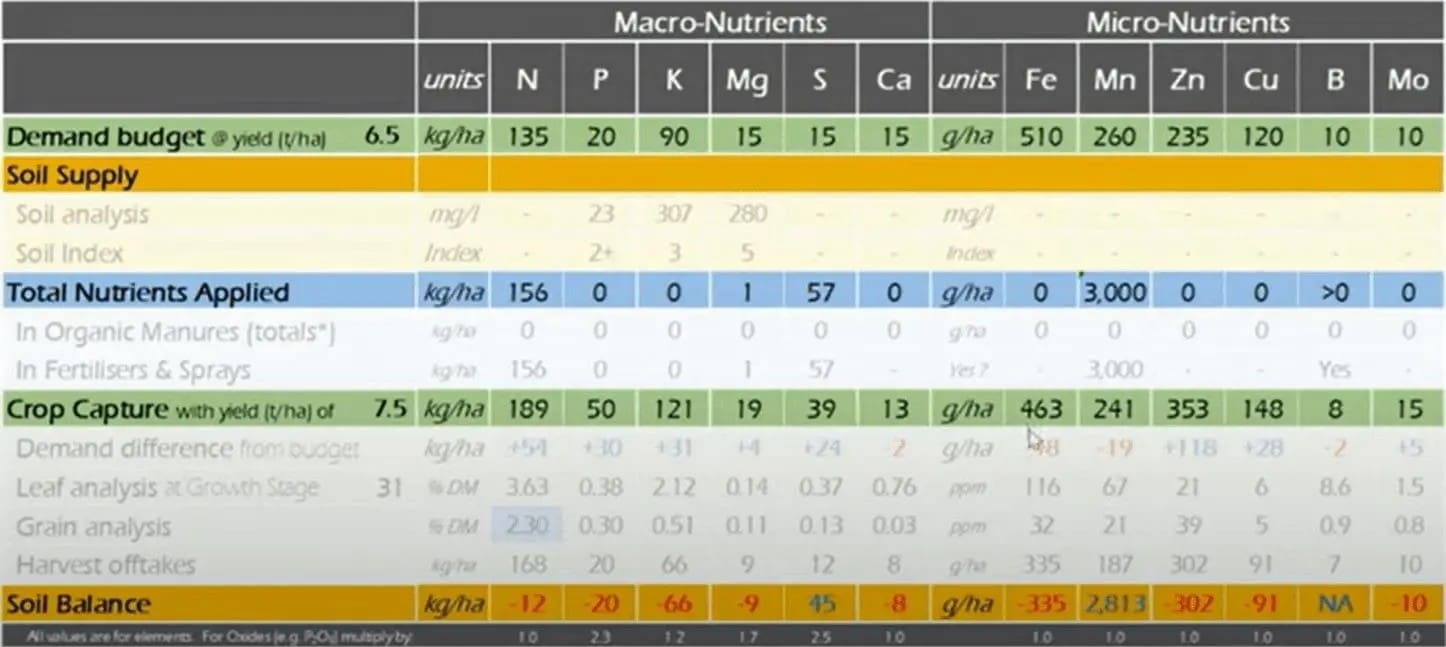
Once harvest is complete, Tamara recommends that farmers complete a field nutrient account – listing the soil analysis results, total nutrients applied, results from leaf analysis (if completed), and grain analysis results. Viewing all these nutrient measurements in one place with the final yield will allow growers to determine what nutrients are left in the soil, and provide them with a starting point for drafting the following season’s nutrition plan.
“While having all the data in place might look daunting, a field nutrient account will help greatly with making adjustments. Taking for example phosphate, the recommendations may say we should apply it, but we know from our field nutrient account that offtakes were less than RB209 predicts, so application rates for the following crop could be reduced.”
Diagnosing problems the eye can’t see
The other benefit of grain analysis is diagnosing nutrient deficiencies. Tamara reported that of the 1700 crops analysed with ADAS’ YEN Nutrition grain analysis service, the vast majority of crops – over 85% – were found to have at least one nutrient deficiency. Most had more than one.
“The problem is by the time you do see a deficiency in the crop, it’s already too late to do anything about it. Remembering to do grain analysis at harvest will help you take the right remedial action next year.”
Making it routine on farm
Michael Brewis runs a 430ha mixed farm with his father near Kelso in the Scottish Borders. With the support of his agronomist Jackie Cotton, he has been carrying out in-season N testing, soil sampling, leaf analysis, and end-of-season grain analysis for the last few years in response to rising fertiliser prices.
His advice to anyone looking to optimise their nutrition is to stick with it long-term, and not treat it as a one-off exercise.
“You can’t take one year of data and treat it as gospel. Quite often, there are factors affecting yield outside of your control, so when you want to make changes to your nutrition, you need to be aware of that. Build data over time and not have a knee-jerk reaction based on one bad result.”
Michael adds that for him, his agronomist Jackie has been the driving force, using the N tester every week from growth stage 30 on the farm. Looking back over previous years, Jackie noted that while Michael’s team have been very proactive, there’s still some fine tuning to do:
“Grain analysis results don’t always come back as you expect. We do seem to have cracked nutrition with the oilseed rape crops, getting green results back all the time. With the cereals – winter wheat, winter barley, spring barley – we’re having a bit more difficulty. Sometimes the leaf analysis comes back fine but later the grain analysis is identifying deficiencies.”
“We go to the same places in the field every year for sampling to try and get consistent measurements. Using the same lab for testing helps with making accurate year-on-year comparisons as well.”