Great crested newt surveys
The Wildlife and Countryside Act 1981 lists the great crested newt (Triturus cristatus) as a protected species. It also has additional protection as a European Protected Species. As such, it is illegal to capture or disturb great crested newts. Their eggs, breeding sites and resting places are all protected.
The great crested newt is largest of the three UK native newt species. Their distribution is widespread but patchy across the country. They can be a significant planning constraint if a development could impact their aquatic or terrestrial habitats.
Get in touch
A preliminary ecological appraisal (PEA) will help to identify any potential newt habitats
Alternatively, a habitat suitability index (HSI) assessment will check waterbodies in and close to the proposed development area. Local planning authorities are likely ask for a survey if there are ponds on site or near the development. If a suitable habitat for great crested newt is discovered, the next step is determining whether they are present or likely to be absent.
Our ecologists are licensed great crested newt surveyors registered with the Chartered Institute of Ecology and Environment Management (CIEEM) We offer our clients pragmatic, commercially aware mitigation solutions when it comes to protected species.
ADAS pioneered the use of environmental DNA analysis to accurate assess the presence of great crested newt
Methods of surveying
Environmental DNA
Environmental DNA (eDNA) testing can determine if great crested newts have recently been present within a waterbody. Our scientists can test water samples for residual traces of DNA within water bodies. eDNA is rapid and cost-effective when compared to traditional surveying. It also has a longer survey window.
Learn more about our eDNA testing capabilities.
Traditional surveying
If eDNA is not a viable option, we can instead determine the presence or likely absence of great crested newts using traditional survey methods. This can include torching, trapping and/or netting within waterbodies.
The survey season window is narrow and only lasts from mid-March to mid-June.
Half of the surveys at each waterbody need to be carried out during the peak breeding time of mid-April to mid-May. Surveys must be properly planned in advance or else there could be significant project delays.
If great crested newts are present
If the species is present, we will carry out further survey work to determine the population size. Only suitably qualified and licensed ecologists can conduct these surveys.
Applying for a licence
If impacting great crested newts is unavoidable, you will need to apply for a European Protected Species (EPS) mitigation licence from Natural England. Our ecologists can apply for a licence on your behalf.
Apply for EPS mitigiation licenceMitigation calendar
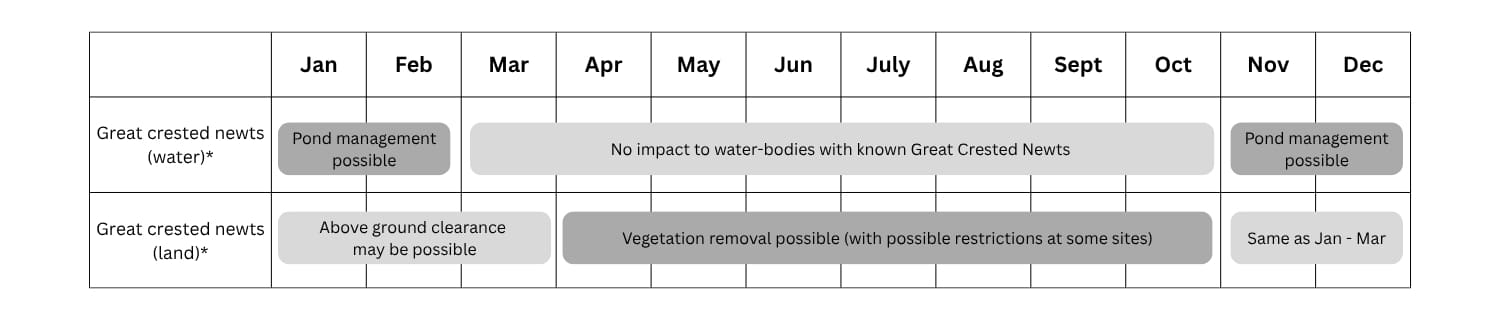
Mitigation may range from temporary exclusion measures to translocation of the population and creation of compensatory habitat.
- GCN (water)* – Jan – Feb – Pond management possible, Mar – Oct – No impact to water-bodies with known Great Crested Newts, Nov – Dec – Pond management possible
- GCN (land)* – Jan – Mar – Above ground clearance may be possible, Apr – Oct – Vegetation removal possible (with possible restrictions at some sites), Nov – Dec – Above ground clearance may be possible
*Please note the process to apply for a European Protected Species Mitigation (EPSM) Licence can take some time. It requires recent survey work at the site for this species and survey work is seasonally constrained.